Monday, June 27, 2011

Voluptuous Female Paleolithic Figurine...

This piece of artwork was suggested to me by my friend Allyssa. So I decided to showcase it here on my blog! I went a little crazy on the artists thoughts, but this piece of work stirred up something inside me. So for that I say thank you, Allyssa.


Venus of Hohle Fels

Artist: Unknown
Year: Upper Paleolithic - 35,000 and 40,000 years ago
Type: Carved Figurine (Wooly Mammoth Tusk)
Dimensions: 2.4 Inches High (6 cm)
Location: Schelklingen, Germany

Brief History: The 40,000 year old figurine of a voluptuous woman carved from mammoth ivory and excavated from a cave in southwestern Germany is the oldest known example of three-dimensional or figurative representation of humans and sheds new light on the origins of art, researchers reported Wednesday.

The intricately carved headless figure is at least 5,000 years older than previous examples and dates from shortly after the arrival of modern humans in Europe. It exhibits many of the characteristics of fertility, or Venus, figurines carved millenniums later.

The figurine was excavated at Hohle Fels, a large cave in the Swabian Jura region about 14 miles southwest of the city of Ulm. The cave shows evidence of a long period of prehistoric occupation. The new figurine was found in six pieces about 9 feet below the cave floor. Nearby were flint-knapping debris, worked bone and ivory, and remains of horses, reindeer, cave bears, mammoths and ibexes.

Radiocarbon data indicate that the layer originated 35,000 to 40,000 years ago.

The figure, about 2.4 inches tall, was carved from a mammoth tusk. It has broad shoulders, prominent breasts and intricately detailed buttocks and genitalia, all grossly exaggerated.

The figurine has two short arms with carefully carved hands resting on the upper part of the stomach; part of the left arm and shoulder are missing. One hand has five fingers, the other four.

The legs are short, pointed and asymmetrical, with the left noticeably shorter, typical of later Venus figurines. Also typical, the figure has no head. Instead, it has a carefully carved ring above the left shoulder. The polished surface of the ring suggests that the figurine was worn as an ornament around the neck.

Many researchers believe that they were fertility totems, but their ultimate meaning may remain a mystery.


An Artists Thoughts: Francis Bacon wrote, "There is no excellent beauty that hath not some strangeness in the proportion", I believe that our earliest ancestors understood that beauty was a woman who showed a full figure and the ability (see: large breasts) to provide for her offspring.

Beauty has changed throughout the ages, body types morph into what is considered gorgeous, sexy, and accepted. Look at the movie industry for example some of the most beautiful women in the 1920s-1950s were Marion Davies, Greta Garbo, Bette Davis, Vivien Leigh, Grace Kelly, Ava Gardner, and Elizabeth Taylor. They graced the posters and walls of many men, and were thought to be the epitome of beauty and grace. In 2011 I highly doubt that any of these women would land the starring role in a motion picture. They would be turned away at the door, saying they were too heavy or not pretty enough.

The same goes for a women's pregnancy. In the early part of the 20th century pregnant women were expected to be covered and take it easy, often confined to their beds. But today women wear pretty much the same things they would if they weren't pregnant, and continue on with their day to day lives. I think the women's movement helped a great deal in that department too. I do think that people find pregnant women more beautiful in the 21st century, before they were thought to be in a weakened state. Now they are seen as strong and gorgeous, often with a glow about them.

The way women are viewed post-pregnancy in this day and age is something that is hard to swallow. Look through any gossip magazine and you will see slender actresses and supermodels who show off their "post-baby bods" only weeks after giving birth. They are applauded and shown always in the most flattering of ways, having looked no different than before the pregnancy. Then comes along Pink. Just days after giving birth, she and her husband decide to go to the beach and she makes all the headlines! Showing that she still has a pregnancy belly, and that her face appears fuller, she was not applauded, she was seen as weak and frumpy. All for becoming pregnant and gaining weight.

Now I'm sure if I was a thin person, I would look at all of this in a different light. I wouldn't be sitting here complaining about how women are judged on their weight and what the views on beauty are. I'd probably be talking about how this figurine is ugly, and that our ancient ancestors must have been crazy for thinking that this could ever pass for beautiful. But I'm not, so you're stuck reading this.

I truly think that Homo sapiens saw something beautiful when they carved this. If it was used for fertility, then those who sought its help must have felt the same way too. To use the oft quoted cliche: beauty is in the eye of the beholder. And for our ancient ancestors, they found beauty in what we would call ugly.

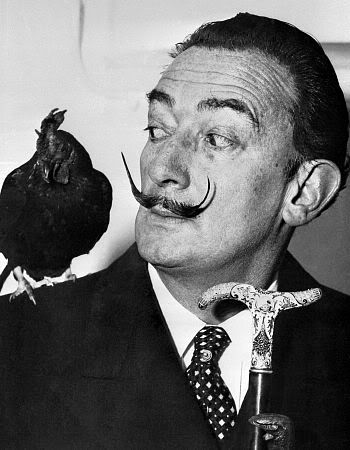
Friday, June 17, 2011

When I paint, the sea roars. The others splash about in the bath.


Salvador Dali

Born: May 11, 1904 - January 23, 1989
Nationality: Spanish
Field: Painting, Drawing, Photography, Sculpture, Writing
Training: San Fernando School of Fine Arts, Madrid
Movement: Cubism, Dada, Surrealism

Brief History: Salvador Domingo Felipe Jacinto Dalí i Domènech, Marquis of Dalí de Púbol (May 11, 1904 – January 23, 1989), commonly known as Salvador Dalí, was a prominent Spanish surrealist painter born in Figueres.

Dalí was a skilled draftsman, best known for the striking and bizarre images in his surrealist work. His painterly skills are often attributed to the influence of Renaissance masters. His best-known work, The Persistence of Memory, was completed in 1931. Dalí's expansive artistic repertoire includes film, sculpture, and photography, in collaboration with a range of artists in a variety of media.

Dalí attributed his "love of everything that is gilded and excessive, my passion for luxury and my love of oriental clothes" to a self-styled "Arab lineage," claiming that his ancestors were descended from the Moors.

Dalí was highly imaginative, and also had an affinity for partaking in unusual and grandiose behavior, in order to draw attention to himself. This sometimes irked those who loved his art as much as it annoyed his critics, since his eccentric manner sometimes drew more public attention than his artwork.


I had always been a fan of Salvador Dali, he has been an amazing influence on my art. But I never really grasped what an amazing artist he was until I visited the Salvador Dali Museum in St Petersburg, FL, it has one of the world's largest collections of Dali's works.

It was the first time that I had been surrounded by so many famous paintings in my life, not to mention that they were all by one of my favorite artists. I couldn't believe that one person could create so many amazing pieces of art.

Dali was a very eccentric person, and his art often reflected his madness! Yet from all of his oddities we are left with one of the most recognized pieces of art work, The Persistence of Memory.


The melting clocks, the arid landscape, the mountains in the background - they all seem to be such random objects, yet grouped together they form a striking painting that seems to be seered into the memory.

Wednesday, September 1, 2010

It is modern art's most powerful antiwar statement...

Guernica

Photobucket

Artist: Pablo Picasso
Year: 1937
Type: Oil on Canvas
Dimensions: 137.4 in × 305.5 in
Location: Museo Reina Sofia, Madrid

On April 27th, 1937, unprecedented atrocities are perpetrated against the civilian population of a little Basque village in northern Spain. Chosen for bombing practice by Hitler's burgeoning war machine, the hamlet is pounded with high-explosive and incendiary bombs for over three hours. Townspeople are cut down as they run from the crumbling buildings. Guernica burns for three days. Sixteen hundred civilians are killed or wounded.

By May 1st, news of the massacre at Guernica reaches Paris, where more than a million protesters flood the streets to voice their outrage in the largest May Day demonstration the city has ever seen. Eyewitness reports fill the front pages of Paris papers. Picasso is stunned by the stark black and white photographs. Appalled and enraged, Picasso rushes through the crowded streets to his studio, where he quickly sketches the first images for the mural he will call Guernica. His search for inspiration is over.


It's sad to admit that I first heard about this painting on a little television show called Queer as Folk. One of the characters was saying that art changes people, that it gets them to do something they rarely do: THINK. I quickly looked up the painting in question, and it blew me away. Not only by its size, but by the subject matter. The first thing you notice is the tangle of limbs and bodies scattered throughout the piece. Next is the lack of color. This painting is done entirely in black and white, yet it invokes so much emotion and calls attention to the crime it portrays.

This is one of those rare paintings that is so powerful and meaningful, yet its something most people have never heard of before. And its almost never mentioned in art history classes.

I think that people like art that is safe. They want flowers and trees and people walking in the park. They don't want death and destruction and truth. They don't want to know what human nature is capable of. This apocalyptic vision of the destruction of a tiny town in Spain will always serve as most powerful anti-war statement ever made.